
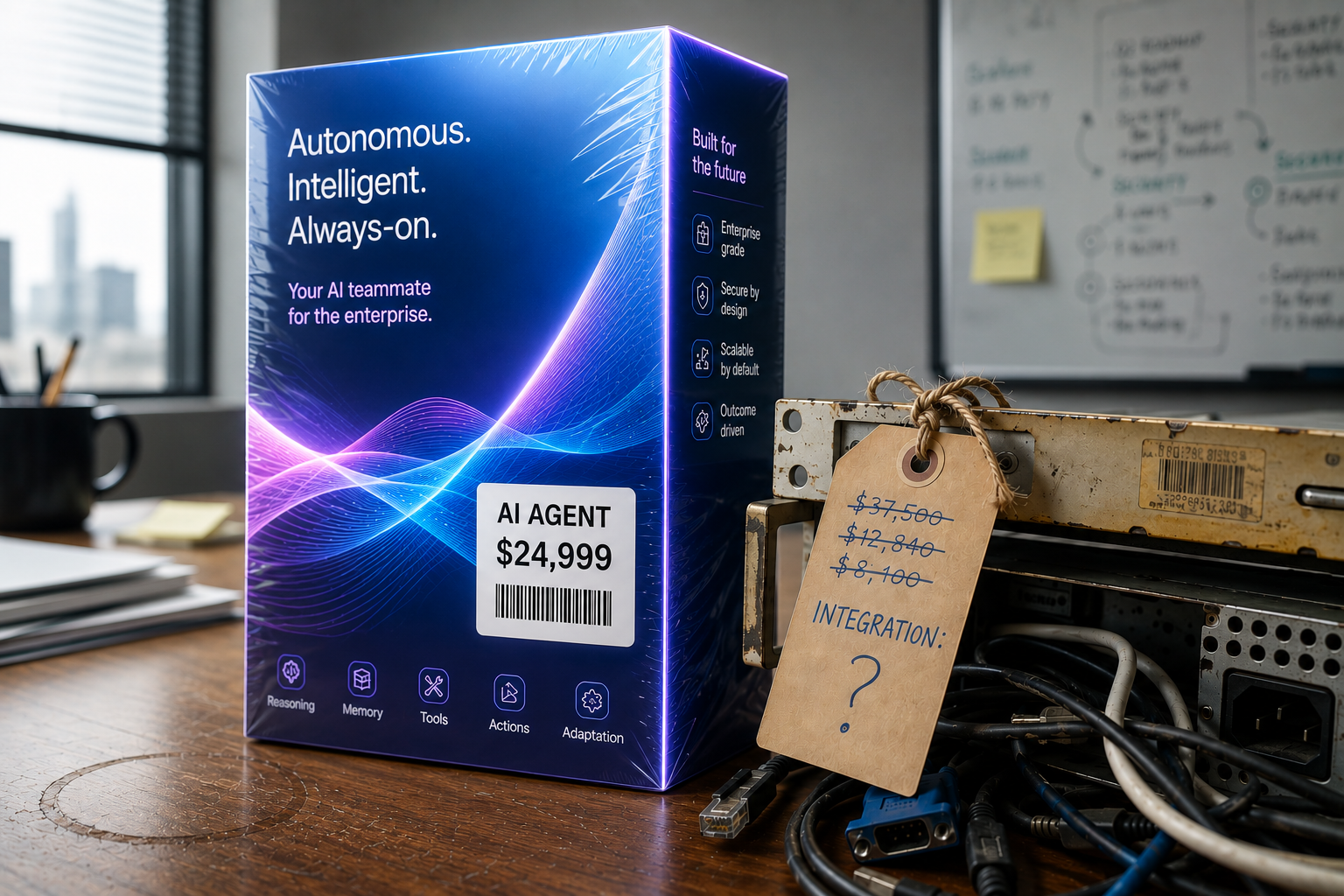


While half the industry writes obituaries for the billable hour, a queue is forming on the other side of the office. A bank wants a claims agent wired into a thirty-year-old policy system. A retailer wants an inventory agent that reads from three databases nobody fully understands anymore. The platform vendor sold them the agent. Nobody sold them the part where it has to work inside their actual business. That part is landing on firms like yours, and it is piling up faster than anyone is talking about.
This is the side of the AI shift the doom narrative skips. The agent is a product. Making it useful inside one specific enterprise, with its data, its systems, and its politics, is bespoke services work. And scoping AI integration projects is turning out to be the hardest estimating job most firms have faced, because almost none of it has been done before.
The vendor ships the agent, not the integration
A coding agent or a customer-service agent is a capability. It does a general thing well. What it does not do is know that your client's billing system has four undocumented states, that the data team is mid-migration, or that the head of ops will veto anything that touches the month-end close. None of that ships with the agent. All of it has to be discovered, mapped, and built around.
BCG put a number on the size of this. Its read is that AI agents are net expansionary for services, with up to $200 billion of net-new demand to wire agents into messy enterprise systems. That figure is a forward-looking BCG estimate, not a measured market, so hold it loosely. It is one supporting point, not the argument. The argument is the thing under it: the platform sells the agent, and someone still has to make it work in a real business. That someone is a consultancy, an SI, or a specialist engineering practice, and the work is real, growing, and new.
Be honest about the other side too. This is early and contested. There is documented, modest AI-led deflation on legacy work, a few percent, as routine delivery gets cheaper. The picture is not that work is vanishing. It is that work is changing shape, from familiar build-and-run toward novel integration nobody has a template for.
Novel work has no priors, which is exactly what breaks the estimate
Here is the operator problem hiding inside the opportunity. Most estimating runs on memory. You scope the new thing by remembering what the last similar thing took. The CRM rollout, the data warehouse, the mobile build. You have done thirty of them, the variance is tight, and your number is a calibrated guess dressed as a quote.
Novel integration work has no last time. The first agent you wire into a client's claims system is the first one anyone has wired into that system, that way, under those constraints. There is no row in your history to anchor to. The estimate cannot lean on "what it took before" because there is no before. That removes the single thing that made your estimates reliable, and it does so on exactly the work that is growing.
This is what people miss when they say AI will make estimation obsolete. The opposite happens. When the work was repeatable, a rough estimate was fine, because the variance was small and the client funded the overrun anyway. When the work is novel, the estimate carries real risk, the spread is wide, and (especially if you sold it as an outcome) the overrun comes straight out of your margin. Harder to get right, and more expensive to get wrong. That is not estimation becoming less valuable. That is it becoming the part of the deal that decides whether you make money.
Scoping AI integration projects with no comparables
You cannot conjure priors you do not have. So you estimate differently, on purpose.
Estimate from first principles, not from analogy. Break the integration into the parts you genuinely understand and the parts you are guessing at. Auth, a known API, a standard data pipe: those you can price from experience. The agent's behaviour against an undocumented legacy system: that you cannot, and pretending otherwise is where the margin goes. Separate the two so the guesswork is visible instead of smeared across a confident-looking total.
Quote a range, and make the range explicit. Novel work has wide variance, so a single point estimate is a lie you tell yourself. If two senior people scope the same integration and land forty percent apart, that gap is the actual uncertainty, not noise to average away. Carry the spread into the number and into the conversation with the client.
Buy down the uncertainty before you commit a price. The strongest move on genuinely novel work is to not price the whole thing up front. Sell a small, paid discovery phase first: a few weeks to probe the real system, test the agent against real data, and find the landmines. You come out of it with priors you did not have going in, and you price the build against something you have seen rather than something you imagined. It also protects the client, which makes it easier to sell than it sounds. If you are weighing how to price the build that follows, the resource mechanics for agent-assisted delivery are a separate piece.
Capture every estimate so the next one is less novel. The first integration of its kind is a blind guess. The second should not be. The only way that happens is if the first one leaves a record: what you assumed, what you estimated, what it actually took, and where the two diverged. Most firms lose that the moment the deal closes and the spreadsheet gets overwritten by the next redraft. Capturing each estimate as structured data is how a firm builds its own priors on work the market has none for. In Estii, a deal template turns a scoped integration into a reusable structure for the next one of its kind, and an automatic deal version snapshots the assumptions each estimate was built on, so the second bespoke deal starts from evidence instead of memory.
The work is transforming, not disappearing
The narrative says AI is coming for professional services. The narrower, truer version is that AI is changing the work, and the new work is harder to scope than the old. The familiar deliveries deflate a little. The novel integrations grow, and they arrive without the comparables that made estimating feel safe.
That is the inversion worth sitting with. For decades the estimate was a formality, a calibrated number off a long history. On the work that is now growing fastest, the history does not exist, the variance is wide, and the price carries the risk. The firms that come through this will not be the ones with the best agents. The vendors sell those. They will be the ones who can put a defensible number on work nobody has priced before. The billable hour can die on schedule. Knowing what the work actually takes only gets more valuable from here.