
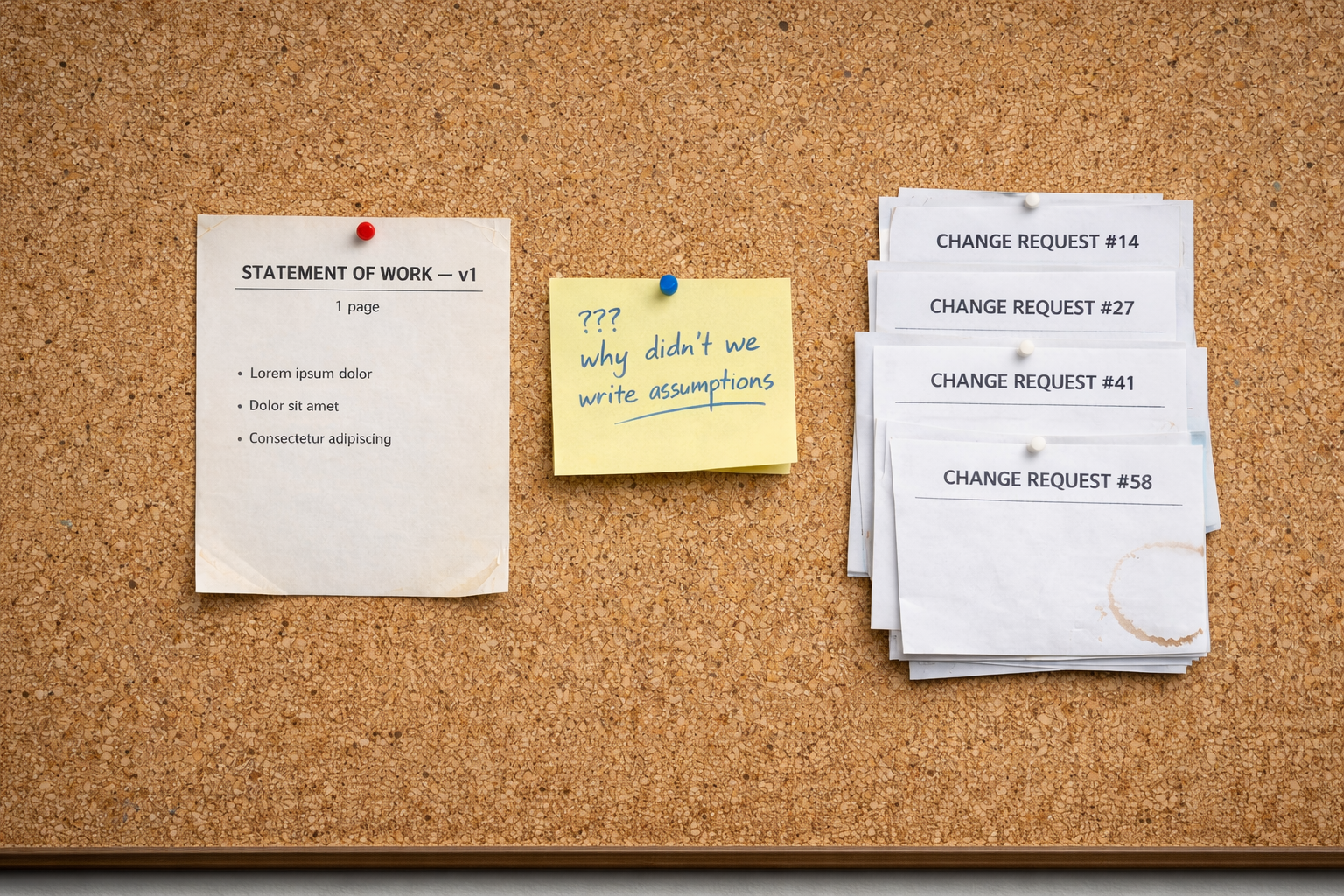


Statements of work are the contract annex that turns a proposal into a commitment. They also break in predictable ways: scope drifts, assumptions go missing, prices stop matching the estimate, and change requests eat margin nobody thought was at risk.
This guide is the reference half. What a statement of work actually is, how it differs from a proposal and a master services agreement, why most SOWs fail in practice, and the nine sections every SOW needs. For the process half (how to generate a SOW from a priced estimate without rekeying it), see SOW generation from a priced estimate.
What a statement of work actually is
A statement of work is the contract annex that defines what the customer is buying for this engagement. It sits under a master services agreement or framework contract and says what is in scope, what is out, how it will be delivered, what it costs, and how changes are handled.
It is not the proposal. The proposal sells the work. The SOW commits to it. The two documents should say the same thing, but they do different jobs and they cross different desks. Confusing them is how teams end up with a slick proposal the buyer loved and a SOW legal won't sign.
SOW vs proposal vs MSA
Buyers and sellers use the three words interchangeably, which makes the handover meeting harder than it needs to be. They are different documents with different lifetimes and different signers.
| Document | Primary job | Lifetime | Typical signer |
|---|---|---|---|
| Master services agreement (MSA) | Legal framework for doing business at all: IP, liability, confidentiality, governing law | Years, often the life of the relationship | Procurement and legal |
| Proposal | Sell the work: commercial narrative, pricing, value case, team story | One deal, often discarded after signing | Buyer sponsor and finance |
| Statement of work (SOW) | Commit to the specific engagement: scope, price, schedule, assumptions, acceptance | One engagement, lives until delivery closes | Buyer sponsor, legal, and the MSA signers |
In practice, most deals sign an MSA once and stack SOWs under it for each engagement. Proposals sit above as the selling artefact and rarely get referenced after the SOW is signed. If your team is rewriting MSA terms into every SOW, you are doing twice the work and creating twice the risk.
Why most SOWs fail in practice
The dominant workflow in project-based firms is still some version of: spreadsheet for the estimate, Word document for the SOW, deck for the proposal, CRM for the pipeline. Four tools, four sources of truth, zero links. When a seller changes the price on Thursday afternoon, three artefacts go stale and someone has to remember to update the other two before the buyer signs.
The failure modes are predictable.
Version drift. Sales sends a revised estimate. The SOW author was on leave. The version that hits legal is two prices behind, and the audit trail is a Slack thread.
Scope drift. The estimate has twenty-three deliverables across four workstreams. The SOW collapses that into eight narrative paragraphs because the Word template has no room for detail. Delivery gets a narrative, not a deliverables list, and the first change request is an argument about what was promised.
Assumption loss. Every priced estimate carries assumptions. Rate of customer feedback, environment access, third-party data availability. Those only protect margin if they make it into the signed document. A Word SOW tends to lose them because no one wants to paste sixty bullets into a contract.
Role inflation. The estimate priced one architect and two senior engineers. The SOW says "a team of senior engineers and architects as required." That language is how a 50% gross margin becomes 30% by month three.
Commercial reconciliation. The spreadsheet says $480,000. The proposal says $475,000 because someone rounded. The SOW says $480K but the payment schedule adds up to $475,000. You pick which one to honour after the customer notices.
What belongs in every SOW
Formats vary by industry, contract type, and buyer maturity. The content does not. If a SOW is missing any of the following, someone on either side will pay for it later.
Deliverables. A named list of what the customer is getting. One sentence per deliverable. Delivery teams read lists; lawyers write them. Serve both.
Scope inclusions and exclusions. What is in, what is explicitly out. Exclusions are the fence that stops scope creeping during delivery. If you cannot write ten exclusions for a six-figure SOW, you have not stress-tested the scope.
Assumptions. The preconditions that make the price valid. Environment access within two weeks of kickoff. Product owner available weekly. Source systems documented to an agreed standard. Each assumption maps to a risk; if the assumption breaks, what happens commercially.
Roles and responsibilities. Who on your side does what, who on theirs. Decision rights, escalation paths, approval authority. Vague roles here is where "one architect for the duration" becomes "four architects on a rotation."
Schedule and milestones. Start date, end date, phasing, key milestones tied to deliverables. If revenue recognition or payment triggers are tied to milestones, milestones have to be precise enough to hit. "End of discovery" is not a milestone. "Signed-off discovery report per Appendix B" is.
Commercials. Total price, breakdown by phase or workstream or role, payment schedule, invoicing cadence, expenses policy, currency, and tax treatment. For time and materials SOWs, the rate card, minimum and maximum hours, and the reporting cadence.
Change mechanism. How scope changes are raised, priced, approved, and appended. Change requests are the number-one margin leak on fixed-price SOWs. If the mechanism is "by mutual written agreement," you have not agreed anything.
Acceptance criteria. What has to be true for each deliverable to be accepted. Ambiguity here is what turns the last 5% of a project into 20% of the effort.
Dependencies and termination. What you need from the customer, by when, and what happens if it does not show up. How the SOW can be paused or ended and how final invoicing works.
Common SOW mistakes
- Writing the SOW before the estimate is locked. You will rewrite both.
- Putting the price in the SOW but not the breakdown. Legal will ask for it anyway.
- Leaving assumptions in a cover letter. Cover letters do not get signed.
- Using "best effort" language in a fixed-price SOW. Pick a model.
- Missing the change mechanism. The single most expensive omission.
- Narrative scope instead of listed scope. Delivery teams cannot read narratives at 2am.
- Rate cards that do not match the estimate. The first invoice will expose it.
- Milestones tied only to calendar dates. The first delay cascades into payment.
Where Estii fits
A SOW is most useful when it is generated from the same priced estimate that drove the proposal, not rebuilt in Word. Estii's scope, schedule, and proposal pages share one commercial model, so the SOW appendix renders from the deal you already priced, with the same line items, rates, and payment milestones. For the full generation workflow and the change-request mechanics, see SOW generation from a priced estimate, or try Estii for free at estii.com.
Wrapping up
A SOW is not a document-formatting problem. It is where scope, price, and delivery margin either get protected or quietly erode. Cover the nine sections above, name the exclusions and assumptions, define the change mechanism, and render the commercial sections from the estimate instead of retyping them. The rest is execution.
FAQ
What is the difference between a SOW and a proposal?
A proposal sells the work. A SOW commits to it. The proposal is a sales artefact with a commercial narrative, pricing, and value case. The SOW is a contract annex that defines scope, schedule, commercials, assumptions, and acceptance for a specific engagement.
Do I need a SOW if I already have an MSA?
Yes. The MSA sets the legal framework (IP, liability, confidentiality, governing law). The SOW defines the specific engagement: what you are building, when, for how much, under what assumptions. An MSA without a SOW says you have a relationship but not what you are doing this quarter.
What should I never leave out of a SOW?
Deliverables, assumptions, exclusions, commercials, change mechanism, and acceptance criteria. Missing any of these is a future dispute. Missing the change mechanism is the one that costs the most.