


A buyer wants to say yes. Budget is roughly there, the relationship is warm, the work is a clear fit. Then the deal goes quiet.
The firm reads the silence as price. It usually isn't. The JOLT Effect, Matthew Dixon and Ted McKenna's study of more than two million recorded sales calls, found that 40 to 60% of qualified deals are lost not to a competitor but to "no decision". The buyer wanted to move and couldn't finish the decision. The deal you thought you lost to a rival mostly went nowhere.
So the question that matters isn't "why did they choose someone else". It's "why couldn't they finish". Answer that and you understand what actually makes a service offer easy to buy, which has little to do with the deck and everything to do with what the buyer can carry out of the room.
The deal dies in a room you'll never enter
When a deal stalls, firms blame the top of the funnel. The deck wasn't sharp enough, the case study didn't land, the pipeline is thin. So they spend where they can see: more content, a tighter elevator line, another follow-up. The visible surface gets better and the deal still dies.
It dies because the decision moved somewhere you have no access. Gartner puts the typical B2B buying group at six to ten people, each arriving with their own research, and finds 74% of those groups in open conflict during the decision. Your champion has to take your offer into that room and rebuild it from memory for a finance lead who never met you, a delivery owner who wasn't on the call, a CFO who sees one number and no logic.
That's where most deals are won or lost, and it's the one room your messaging cannot reach. The JOLT Effect found most no-decision losses come from buyer indecision, not a preference for the status quo. The buyer wanted to act. They couldn't build the internal case to justify it.
A price-sensitive buyer haggles. A buyer who can't finish the maths disappears. The two look identical from outside, which is why so many stalled deals get a discount they never needed and still go cold. When it genuinely is price, trade for scope or terms instead of cutting the number.
Easy to buy means the buyer can finish the maths without you
Buyability isn't how persuasive your offer is in the room. It's whether your offer survives being re-explained by someone who is not in sales, to people who are not in the mood to be sold.
The buyer in front of you is rarely the one who signs. They're a proxy, carrying your number into a room you don't control, defending it against people whose job is to find the hole. If your proposal is one figure with no visible structure, you've handed your champion nothing to defend with, and the conversation happens without you.
An offer is easy to buy when the buyer can reconstruct it alone: what they're getting, why it costs what it costs, what's fixed, what flexes, what happens if the work runs long. Not your margins. Enough shape to walk the number into a hostile room and have it hold.
Three stories the buyer has to reconcile
Here is the part most firms never see, because it happens inside their own building. Sales sells an optimistic scope. Delivery quietly resizes it to something deliverable. Finance forecasts a third number off its own assumptions. Three teams, three versions of the same deal, and the buyer gets passed between them hearing the offer change shape each time.
You can't write your way out of that. No deck reconciles three documents that disagree. The buyer feels the contradiction even when they can't name it, and a buyer who senses the seams won't stake their own credibility defending your number to their CFO.
It's a structural problem, not a copy problem. When sales, delivery, and finance work from separate spreadsheets, they drift, because the documents let them. When they negotiate, scope, and forecast against one shared object, the story holds by construction. The offer the buyer hears in the sales call is the offer delivery inherits and finance books. This is the case for a single commercial source of truth rather than a folder of spreadsheets that agree right up until they don't.
What a buyable offer puts in the champion's hands
Work back from the room you can't enter and three things matter.
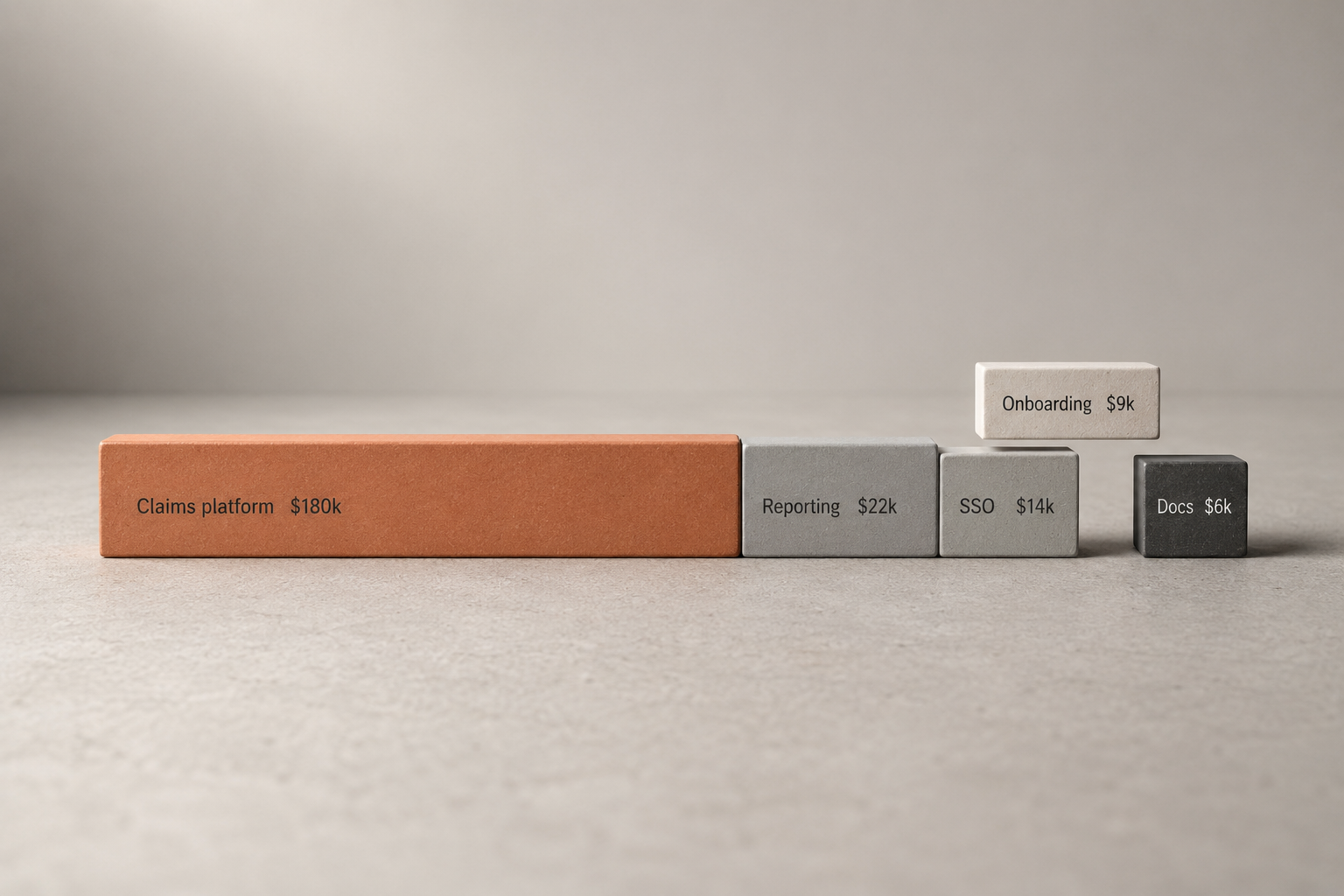
An outcome they can value. Most offers describe activity: a discovery phase, four sprints, five workstreams. Activity is easy to list and impossible to weigh. "A claims platform your team can run without us by Q3" gives the buyer a result to defend. "A 14-week engagement across five workstreams" gives them a cost to question. Same work, different object.
A price with visible logic. The champion has to answer "why this number" without you there. They don't need your margins. They need the structure underneath: what drives the cost, where the effort sits, which parts are fixed and which flex. Show the assumptions and the scope, keep the costs and rates to yourself. Granularity on what they're buying is what makes the number defensible. Granularity on what it costs you just invites a haggle. Whether the shape is fixed price, time and materials, or a retainer is a separate decision worth making deliberately, but whatever you pick, it has to survive being explained by someone who isn't in sales.
A short path to yes. Even a coherent offer cools on a long path. A proposal that takes a week to redraft, options arriving as three separate documents, a SOW that contradicts the deck. Every extra step is another place for the buying group to stall, and stalling is the default they're already fighting.
Be honest about what better words can fix
None of this makes messaging worthless. A sharper headline earns the meeting. A clear case study gets you shortlisted. At the top of the funnel, words do real work.
They stop working at the point the deal actually dies. Once your offer is inside the buyer's org, re-explained by a proxy to a committee, no amount of polish travels with it. What travels is the structure: the outcome, the logic of the price, the consistency between what sales said and what the SOW says. If those don't hold, a better deck buys you a warmer no.
So the honest version is narrow. Fix the words and you win more first meetings. Fix the model and you win the rooms you're not in. Most firms have done the first and skipped the second, which is why the pipeline looks healthy and the close rate doesn't.
A tooling problem before a messaging problem
The offer the buyer defends is only as coherent as the model behind it, and keeping one model coherent across sales, delivery, and finance is a tooling problem before it's a discipline problem.
Because Estii generates the proposal from the deal data, the document the buyer reads is the priced model the team built, not a deck someone retyped, so the offer can't quietly drift between the estimate and the page. On the scope page you toggle line items in and out and watch price, value, and schedule recalculate together, which turns "what's included" into an explicit list the buyer can defend instead of a buried assumption. When the buying group needs to choose, deal versions let you send good, better, and best as snapshots of one model, priced the same way, instead of three documents that disagree.
The point isn't that Estii writes a better proposal. It's that one object behind the offer is what lets sales, delivery, and finance hand the buyer the same number, the only version that survives the room.
What "still thinking about it" really means
Marketing doesn't make an offer buyable. The model does. Fix the model and the words get easier, because there's finally one true thing to say. Leave it contradictory and the buyer feels the seams the moment your champion tries to defend it to someone who wasn't in the room.
No decision is the default. It takes more of your deals than any competitor does. The offers that beat it aren't the ones with the best deck. They're the ones the buyer can pick up, carry into a room you'll never see, and put back down without anything breaking. The rest get filed under "still thinking about it".