



On a vendor call last quarter, the rep opened with "professional services CPQ." I asked what made it "services" instead of just CPQ. He paused. "It's CPQ, but for services firms." That was the whole answer.
Services CPQ is real software with real customers. ScopeStack, Provus, Apropo, and a handful of smaller plays are shipping product, closing deals, and solving a piece of the problem. The category is not vapour. But the category language did not come from professional services firms. It came from the product CPQ industry, looking for adjacent revenue, and was packaged for an audience that never volunteered the term.
This is a guide to what professional services CPQ actually means in 2026, what it solves well, where it leaves services firms exposed, and what a buyer should be evaluating that the category page never mentions.
CPQ came from the product world
CPQ is Configure, Price, Quote. The category was built for firms selling configurable hardware and software: pick a server chassis, add the right amount of RAM, apply the right discount tier, generate the quote, route it for approval, drop it into Salesforce. The mechanics are guided product configuration, pricing rules, discount approval workflows, and quote document generation. Salesforce CPQ, Oracle CPQ, and SAP CPQ own the parent category.
For a hardware reseller this works. The catalogue is finite. The configurations are constrained. The price is the price plus or minus a discount band. The quote is a document that reflects a SKU choice.
Services don't behave like that. There is no SKU for "three-month CRM rollout for a 300-person manufacturer." Every deal is a new shape, with new role mix, new schedule, new assumptions about what the customer is and isn't responsible for. The estimate is the hard part. The quote is what falls out.
When the product CPQ vendors looked at the services market they saw the same surface artefact (a quote document) and assumed the same machinery would work underneath. Services CPQ is the result. The configure step became "guided service scoping." The price step became "rules and approvals on rates and discounts." The quote step became "SOW generation." The shape mirrors product CPQ closely enough that it sells well to RevOps teams who already use one.
It does not always solve the problem services firms actually have.
Quoting isn't the bottleneck
Ask a head of presales at a 200-person systems integrator what slows their commercial process. Almost nobody says "we are slow at producing the quote document." The quote is downstream. What they say, in some order:
- Scope keeps changing during the sale and we have to rebuild the estimate.
- The salesperson promised something delivery can't actually staff.
- The CFO wants to see margin by deal, by practice, by rate card, and we cannot give a straight answer.
- Capacity in July is already 130% subscribed and nobody saw it coming.
- The signed SOW does not match what we estimated and the change requests are leaking margin.
None of these are quote-generation problems. They are commercial coherence problems. The deal moves through stages, the shape of the work changes a dozen times, and the firm needs scope, price, margin, schedule, and capacity to stay in lockstep through every change. A category that ends at "quote sent" is a category that ends one lap before the finish line.
The CPQ vendors who entered services took the parts of the problem that look like CPQ (scoping, pricing rules, document generation) and built around those. The parts that don't look like CPQ (a live commercial model, schedule cascading, capacity visibility, version control on signed deals) tend to sit outside the product or get bolted on as integrations.
That gap is where most services firms get hurt.
Scope as a configurator, not a model
Most services CPQs treat scope as a product configuration exercise. You pick from a service catalogue, the configurator validates compatibility, and out drops a quote. This works if the firm sells a finite number of well-defined service packages. Some do. A managed services provider with three tiers of patching, monitoring, and helpdesk can absolutely benefit from a configurator.
Most technology solution providers don't sell that way. A custom software consultancy, a Salesforce SI, a digital agency, a specialist data team. These firms build solutions whose shape is determined during the sale. The estimate is not a configuration. It is a model.
A configurator asks: which packages did you pick? A model asks: how do effort, value, price, margin, and schedule recompute when you change one assumption?
The difference matters because a configurator dies the first time a customer asks for a 15% discount on a six-figure deal. To respond, the seller needs to descope work. In a configurator that means deselecting packages and watching the price drop in steps. In a model it means clicking on a workstream and watching effort, value, price, margin, schedule, and the resource plan all recalculate together.
If your services CPQ vendor demos scope by toggling line items in a tree, ask them what changes when you toggle. If the answer is "the price total," it's a configurator with a price tag attached. If the answer is "the price, the margin, the duration, the role mix, the milestones, and the resource demand for that role-month," it's a model.
Schedule is a date field, not a plan
The schedule problem is more subtle than it looks. Most services CPQs have a "start date" and "duration" field on the quote. Some let you pick milestones. A few generate a Gantt chart from the line items. Almost none recalculate that schedule when the scope changes.
That sounds like a niche complaint until you watch what happens on a real deal. The customer wants the project to start a month later. The seller adjusts the start date. The price is the same, the SOW renders the new start date, and everyone signs. Six weeks later the resource manager notices the new July start collides with three other deals all needing the same senior consultants. The firm has either overcommitted, or has to push the kick-off again.
A schedule that doesn't drive resource demand is a date field. A schedule that does drive resource demand is a plan. The category boundary between the two is where most services CPQs sit on the wrong side.
There is also a feedback direction most CPQs don't model. Scope changes should reshape the schedule (drop a workstream, the duration shortens). Schedule changes should reshape resource demand (move June to August, the role mix in those months swaps). And every one of those changes should be visible to whoever is forecasting capacity for next quarter, before the deal is signed, not after.
Capacity isn't in the picture
This is the cleanest example of where the product CPQ shape stops working. Product CPQ does not need to know whether the warehouse can ship a thousand servers in July. It is somebody else's job. Services CPQ inherited that assumption and kept it.
For a services firm capacity is the deal. If a £400k engagement closes in May and the firm doesn't have the right senior consultants free in June, the firm just sold a problem. The capacity question is not a delivery-side concern that gets resolved after the SOW is signed. It is a sales-side question that should be asked while the deal is still in pipeline.
Most services CPQs solve this by integrating with a separate professional services automation (PSA) tool, where resource management lives. Two products, two data models, two reconciliation jobs. The CPQ knows the deal. The PSA knows the resources. The integration tries to keep them in sync. In practice they drift.
The buyer's question to ask: when a deal moves from 30% to 60% probability in your CPQ, does the role-month capacity view update in the same product, or does someone export to the PSA and reimport on Friday afternoon?
If the answer involves an export, the capacity view is one Friday behind reality. If the answer involves a separate product, the capacity view is one team behind reality.
Margin protection by rule, not by structure
Most services CPQs ship strong rule engines. Approvals, discount thresholds, rate-card guardrails, deal-desk routing. These are useful. They catch a salesperson who tries to apply a 35% discount when the policy is 20%. They route deals over a margin threshold to a CFO for sign-off.
What they don't do, structurally, is keep margin honest as the deal evolves. A deal estimated with senior consultants at the listed rate, then renegotiated with a cheaper blended rate to win a discount, will pass every rule in the engine and still deliver under-margin if the original effort estimate assumed senior-level productivity. The rule engine catches the thing it was told to look for. It cannot catch the thing the estimate assumed silently.
Structural margin protection looks different. It means the rate card, the role mix, the productivity assumptions, the contingency, and the margin floor are all part of the same model, and changing any one of them updates the margin in the same place the seller is negotiating. The check is not "did the discount break a rule." The check is "does the price still hold the margin floor given everything else we just changed."
This is not a rule problem. It is a model problem. A CPQ that treats margin as a rule will catch some leaks and miss others. A commercial model that treats margin as an emergent property of the structure catches them at the source.
Quote is the output, not a view of the live deal
The fifth gap is the one services CPQ vendors are proudest of: quote generation. Most of them do this well. Branded templates, structured SOW appendices, e-sign integration, version control on the document. The quote is the marquee feature.
The trouble starts after the quote is sent. In most CPQ workflows the document is the artefact. It is a snapshot of the deal at the moment of generation. If the deal changes (the customer pushes back on scope, the start date moves, the rate card updates), the quote is regenerated as a new document. The previous quote becomes a stale file in someone's downloads folder.
That model works for a hardware quote signed within days of being sent. It strains for a services deal that is in negotiation for weeks, with three rounds of scope changes and two rounds of pricing changes, where the firm needs to know "what was the version we sent on the 14th, and what changed by the 21st."
A live deal model treats the quote as a render. The deal is the source. The quote is the latest view. Versions are pinned automatically when the deal is approved or sent, not when someone remembers to save a copy. The change history lives on the deal, not in an email thread of attachments.
This is a small distinction in a demo and a large distinction at month three of a complex sale.
How the named vendors handle the five gaps
A snapshot of how four products in the services CPQ buyer set sit against the five gaps above. Read this as a starting shortlist, not a verdict. The table is built from current vendor pages and the language each product leads with, not from deep product testing in your own deal flow. Always confirm with a demo against a real, messy deal of your own.
| Gap | ScopeStack | Provus | Apropo | Estii |
|---|---|---|---|---|
| Scope is a live model, not a configurator | Configurator | Configurator | Configurator with AI estimate | Live, interactive model |
| Schedule recalculates from scope | Static dates | Static dates | Static dates, Jira handoff | Cascades from scope |
| Capacity in the same product | Via PSA integration | Via Salesforce or PSA | Via Jira reporting | Native, three layers |
| Margin protected structurally | Rules and approvals | Rules and approvals | Rules | Structural, model-based |
| Quote is a render of the live deal | Document snapshot | Document snapshot | Interactive quote | Live render with versions |
ScopeStack and Provus sit closest to the original CPQ shape, with strong scoping configurators, mature pricing-rule engines, and document-grade quote generation. Both lean on integrations with separate PSA tools for the capacity question. Apropo is the software-project variant of the same wedge, with AI-assisted estimating and Jira handoff bolted to the quote workflow. Estii is the outlier in the table because the centre of gravity is the live commercial model rather than the quote, which is why we don't lead with the category term in the first place. More on that below.
Where Estii fits
Estii is, by buyer search, in the professional services CPQ set. We rank for the term, we get demos from buyers comparing us to ScopeStack and Provus, and we will not pretend otherwise. The product, however, is not built around the CPQ shape. It is built around the live commercial model the gaps above describe. Five mechanics, each tied directly to a gap named in this guide.
Scope as a live, interactive model
Scope in Estii is an interactive pivot over the deal's estimates. Click any priority, item, workstream, or role to descope it. Effort, value, price, margin, and schedule all recalculate across every breakdown in the same interaction. Switch the breakdown to phase, category, role, or stream and the same model is shown a different way. The CFO call where the customer wants 15% off becomes ten minutes of clicking, not three days of rebuilding the estimate.
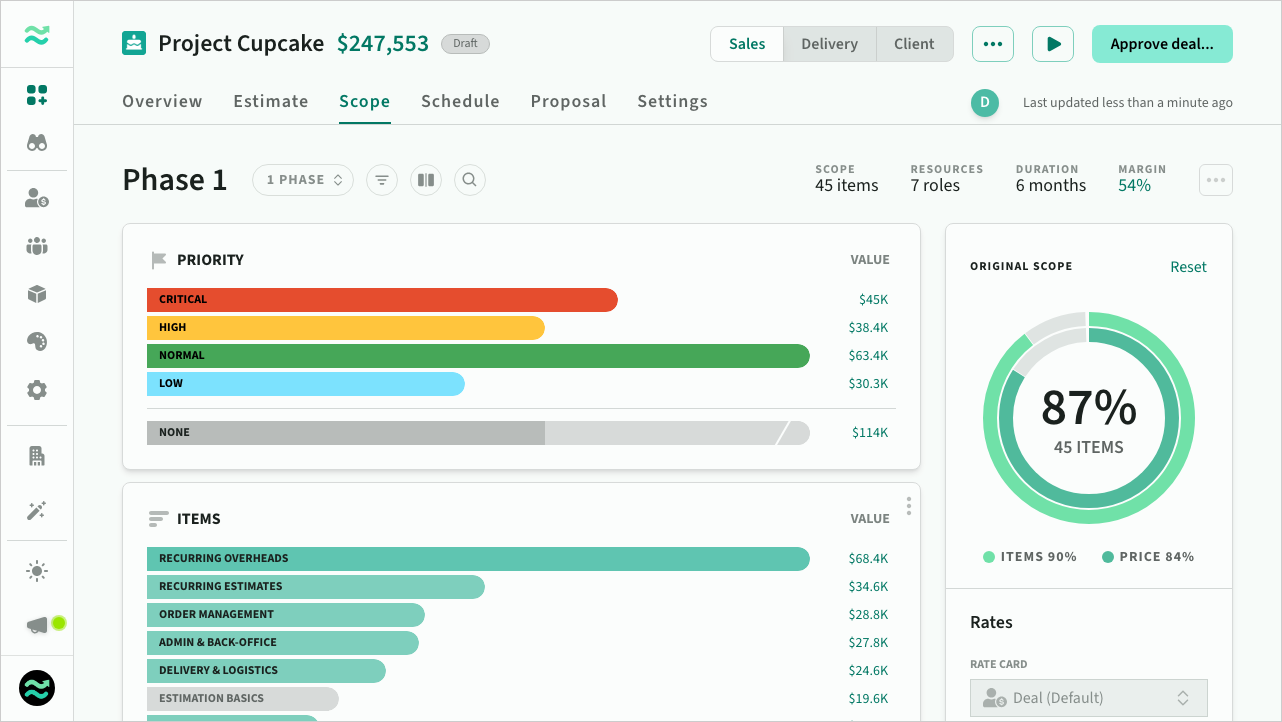 Descoped items shown in grey, price recalculates in real time
Schedule that cascades from scope
The schedule auto-recalculates a best-fit duration and resource plan whenever scope changes. Drop a workstream and the duration tightens, the role mix updates, the recurring roles rescale, and the payment milestones shift. The schedule is not a date field. It is the consequence of the scope, recomputed every time the scope moves.
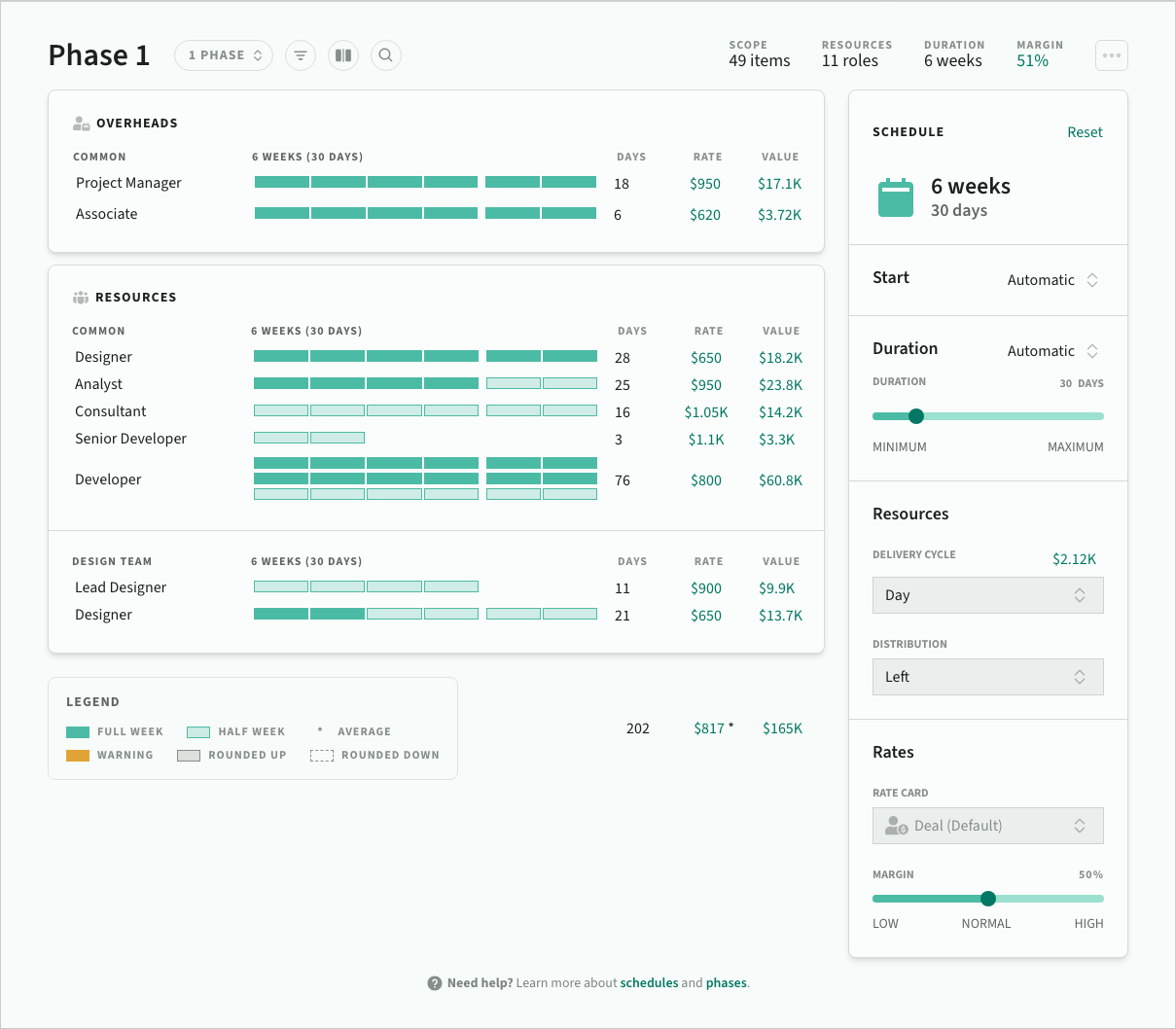 Schedule recalculates from the new scope
Capacity in the same product, not a separate PSA
The Forecasts page reads from the same commercial model the deal is built in. Three layers, named the way delivery already thinks about them: Confirmed (signed work), Forecast (probability-weighted pipeline), Exposure (the if-everything-closes ceiling). Move a deal from 30% to 60% in pipeline and the Forecast layer updates immediately. Change scope on a signed deal and the Confirmed layer updates. There is no separate PSA to reconcile, because the resource demand is a direct read of the same deals the sellers are working.
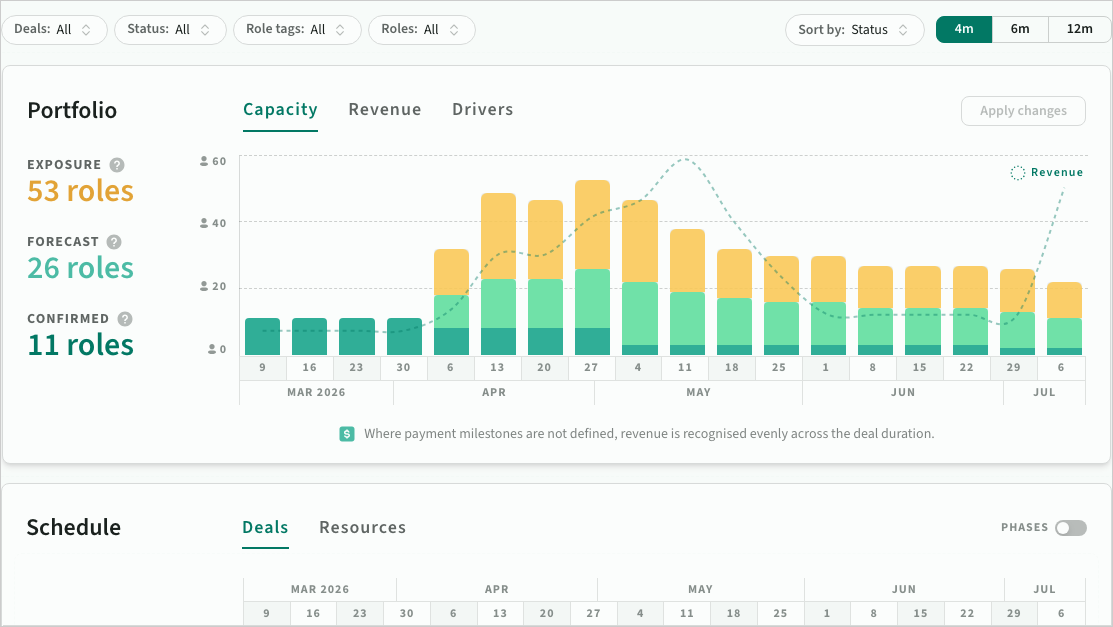 Confirmed, Forecast, and Exposure capacity layers
Proposal and SOW rendered from the live deal
Generated proposals include a structured Scope of Work appendix that itemises every line by phase, category, and section. Slide settings control whether each line shows role estimates, units, and prices, so the same deal can ship a customer-facing SOW with headline numbers and a delivery-facing SOW with the full breakdown. The proposal is not a snapshot saved at generation time. It is the latest render of the live deal, every time it is opened.
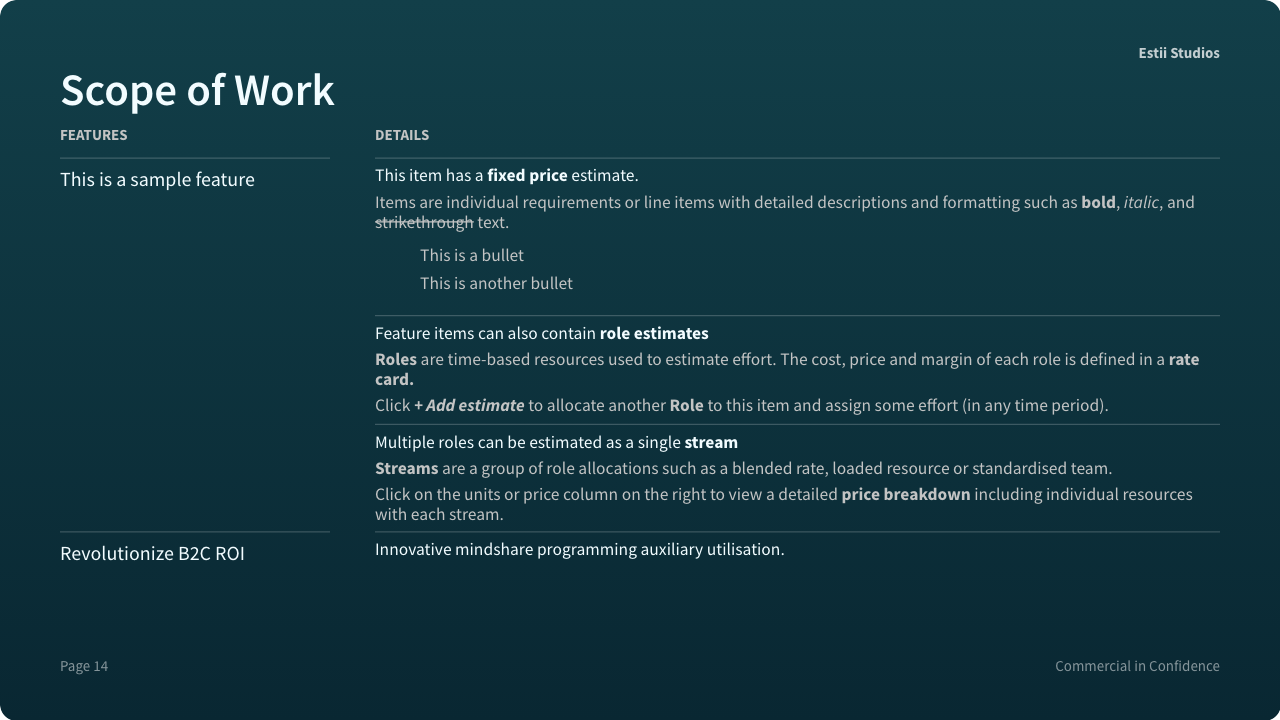 Itemised SOW appendix with estimates, units, and prices
Versions pinned automatically, not manually
Deal versions are created on every redraft, every approval, and every space sync. Approved deals go read-only. Each version has a unique URL for preview or comparison. The change history lives on the deal, so "what did we send on the 14th and what changed by the 21st" is a diff, not an email search.
What this looks like in practice
A seller and a presales lead are on a call with a CFO who wants 15% off a six-figure deal that is supposed to start in June. In ten minutes they descope two workstreams, push the start date to July, and switch one senior consultant role to a senior-plus-junior pair. The price drops 17%. The schedule shortens by three weeks. The Forecasts page shows the July impact across the firm, which surfaces a different problem: the new role mix tips the senior Dynamics line into the red. They drop one of the two workstreams instead, regenerate the proposal, and send the revised SOW that afternoon. The previous version is pinned as "Draft 3, sent 14 April." Nothing was retyped. Nothing drifted. The capacity team did not have to rebuild the resource plan.
You can try Estii for free.
Why we don't lead with "professional services CPQ"
Estii is in the services CPQ buyer set. We will not pretend otherwise. But we do not lead with the term, and we will not put it on the home page.
The reason is not that the term is wrong. It is that the term is dead on arrival in a buyer's head. "Professional services CPQ" reads like an enterprise sales acronym from 2014. It puts the reader to sleep before the second sentence. It also frames the category around quoting workflow, which is one job out of six the actual product needs to do.
We use "commercial estimation software" because that is what the job is. Estimating is the hard part. Quoting is what comes out the other end. Pricing rules, margin policy, schedule, capacity, and the proposal are all downstream of getting the estimate right and keeping it coherent as the deal moves. A category language that names estimation as the centre of gravity, instead of the quote as the artefact, gives buyers a more honest picture of what the work actually is.
If your team's buyer-side language is already "services CPQ," that is fine. Use it as a starting point. Then ask any vendor on your shortlist the questions in this guide. Does scope drive a model or a configurator. Does schedule recalculate or sit as a date field. Does capacity live in the same product. Is margin enforced structurally or by rule. Is the quote a render of the live deal or a snapshot. The answers will tell you which products are CPQ tools with services framing, and which ones are commercial estimation tools that happen to rank for the same search terms.
Wrapping up
Services CPQ is a category that got handed to professional services firms by an adjacent software market. It solves part of the problem honestly and well. It also leaves five real gaps that show up after the quote is sent, when the deal is in negotiation, the scope is changing, and the firm needs scope, schedule, capacity, and margin to stay coherent through every change.
The buyer's job is to know which gaps matter for their business and which vendors close them at the model level rather than the rule level. The category page will not tell you. The demo will, if you ask the right questions.