



Most services businesses cannot tell you the margin on a deal until after it is signed. The CRM holds pipeline, spreadsheets hold the quote, a project tool holds delivery, and finance gets the reconciliation bill at quarter end. Nothing agrees until the forecast has already missed.
This guide is for the person who has to fund the fix. It walks through the business case for an estimation platform: what it does, what outcomes to promise, how to quantify the value without hero assumptions, and how to prove it with a small pilot.
What an estimation platform actually does
An estimation platform is the commercial layer between CRM and delivery. It turns scope assumptions into priced work, applies margin guardrails before a deal is signed, and gives sales, delivery, and finance one version of the same deal to argue over.
It is where "what we sold" and "what it will take to deliver" get negotiated together, with an audit trail.
Three outcomes a CFO will fund
You do not sell a platform on features. You sell it on three outcomes that show up in the quarterly numbers.
Margin you can actually hold. "Target 50% gross margin" is wishful thinking if sellers cannot see margin while they negotiate. A platform lets you set standard rates, margin ranges, and rounding rules once, then applies them to every deal. Exceptions need a reason and an approver.
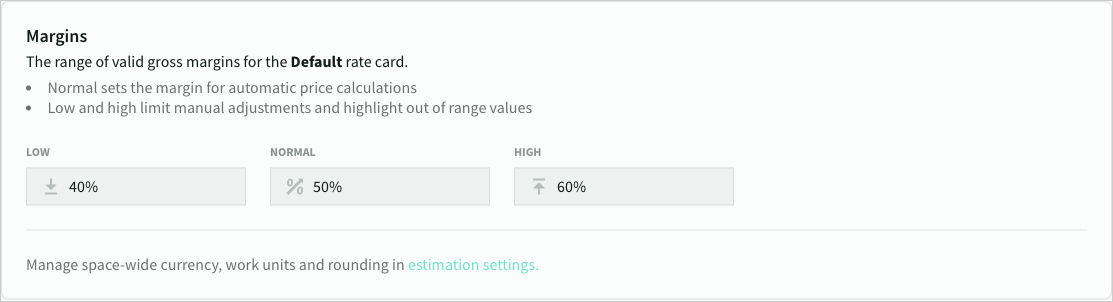 Margin guardrails surfaced inside a deal during pricing
One model, three teams. Sales sells an outcome. Delivery sees constraints. Finance wants predictability. An estimation platform forces that conversation into a shared model of scope, resourcing, price, and payment structure, visible to everyone who owns the consequences.
Less reconciliation. Multiple spreadsheets per deal, multiple versions emailed around, multiple sources for "the" scope. You pay for that twice, in RevOps hours and in margin leakage. One model, exported out to the tools you already run, removes the reconciliation tax.
The one-slide ROI summary
Pick two or three of these and quantify them. CFOs fund focus, not a laundry list.
- Margin improvement from fewer under-scoped deals and less unpriced change
- Cycle time reduction from faster quote iterations and fewer approval loops
- Forecast accuracy because deal economics are explicit before close
If you try to sell all of them at once, the case gets softer, not stronger.
Build the business case in four steps
Step 1, baseline the current state
Answer with examples, not averages:
- How many spreadsheets per deal, and who owns them?
- How often does delivery say "we didn't price this" after signing?
- How long does it take to turn a scope change into a new price and timeline?
Add two or three real deal stories. Stories fund budgets.
Step 2, define targets and guardrails
Make the targets enforceable:
- Target gross margin per service line or region
- Minimum acceptable margin for exceptions, with an approver
- Standard roles, rates, and rounding rules
This turns pricing discipline into a system instead of a training programme. For more on picking defensible margin rules, see the guide on choosing a pricing model and discounting without losing margin.
Step 3, quantify with conservative maths
Use boring assumptions on purpose:
- Realised margin improves by 1–2 points on services revenue
- Quote cycle time drops by 20%
- One fewer unpriced change request per deal
Compare that annual value to platform cost, implementation time, and internal change cost. If the case only works with aggressive numbers, it is not a case.
Step 4, prove it with a pilot
This is how the budget gets released. Propose a tight pilot:
- Pick one service line, region, or sales pod
- Run 10–20 deals through the platform
- Measure quote cycle time, margin variance, and handover issues
- Decide scale-up on evidence, not opinion
Integration without ripping out your stack
RevOps will worry about tool sprawl. They should. The pitch is that the CRM stays the source of truth for accounts, opportunities, and stage forecasting. The estimation platform owns scope, pricing logic, and delivery economics, then pushes structured outputs back into CRM, project tools, and finance.
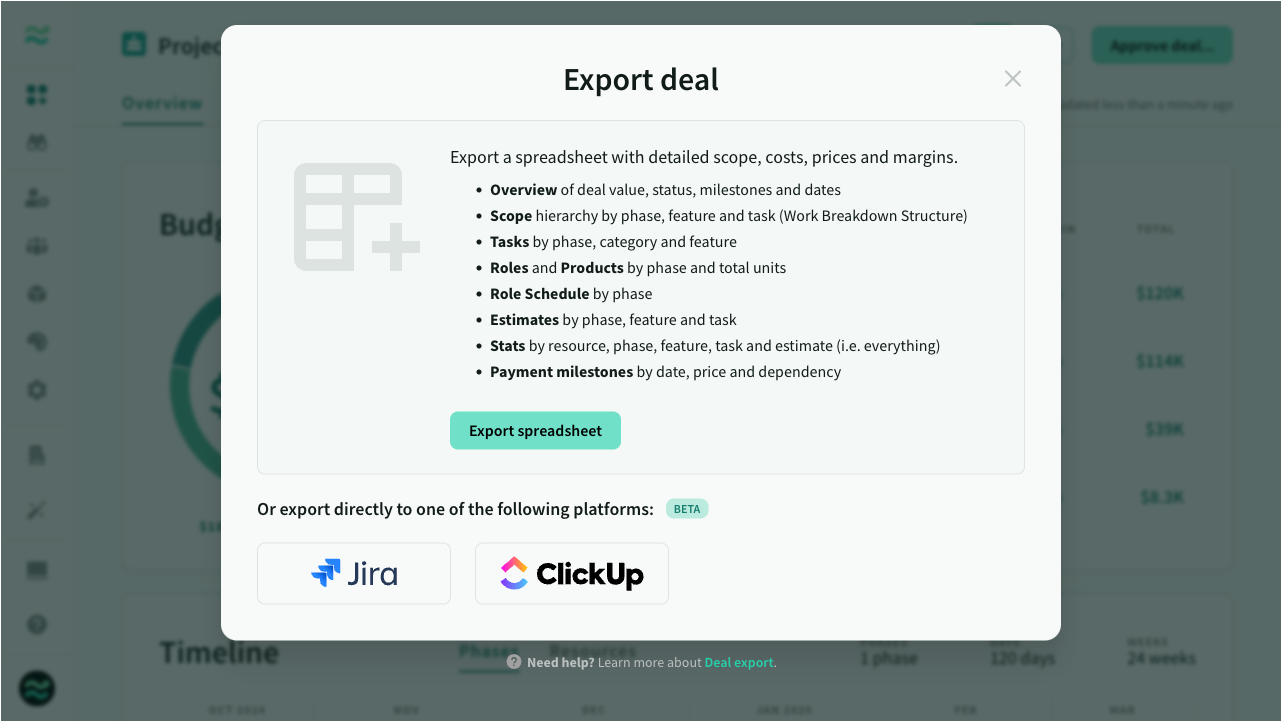 Export dialog offering spreadsheet, Jira, and ClickUp targets
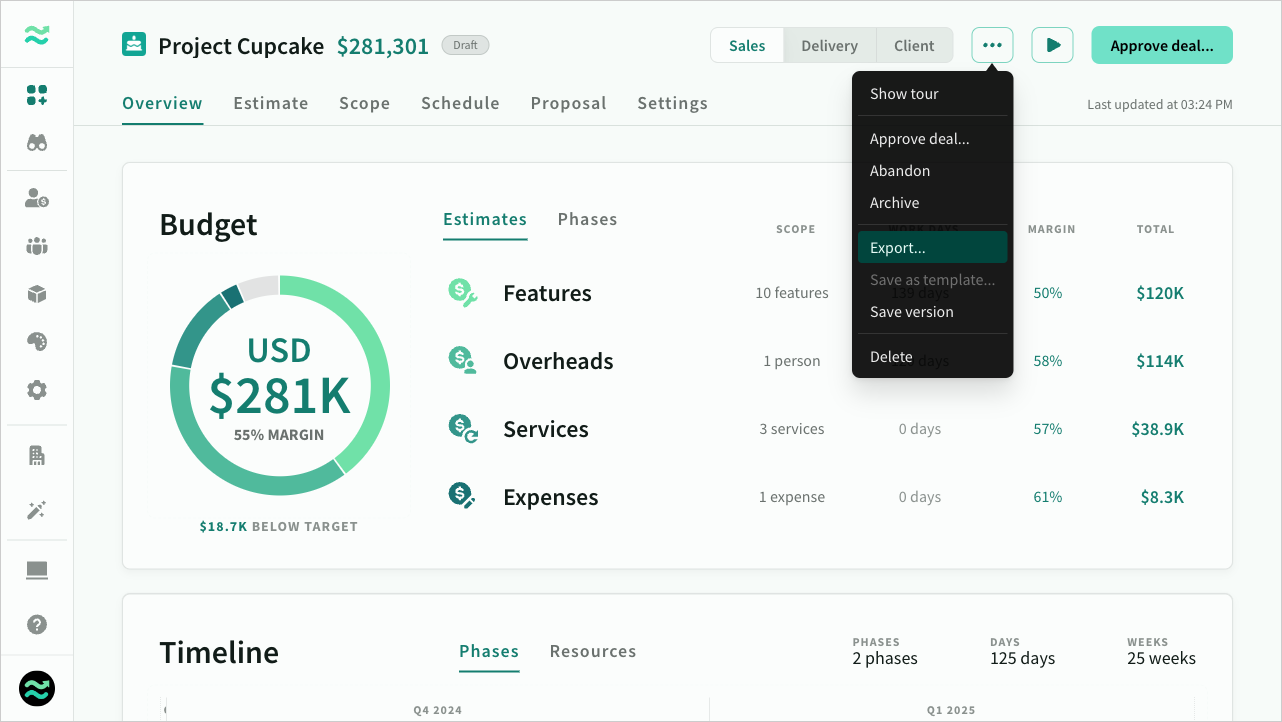 Export menu showing structured outputs for downstream tools
The spreadsheet export ships the full hierarchical WBS with references back to estimates, costs, prices, and margins. Jira and ClickUp exports hand delivery a ready-made project structure without a second round of data entry.
Change management, the honest version
The biggest risk is not the software. It is the embedded spreadsheet process, because that is where your organisation has negotiated reality for years. Expect resistance. Plan for it.
Three things keep a rollout from stalling:
- Shared incentives. Sales wants speed and confidence, delivery wants feasibility, finance wants margin. If the rollout serves one team, the other two will route around it.
- A minimum viable model. Short list of roles and rates, one margin range, a standard structure for scope and assumptions. Add complexity once the basics are adopted.
- Explicit updates. Silent drift in rates and assumptions is why spreadsheets lose trust. Treat upstream changes as reviewable updates so deals stay consistent without surprising anyone.
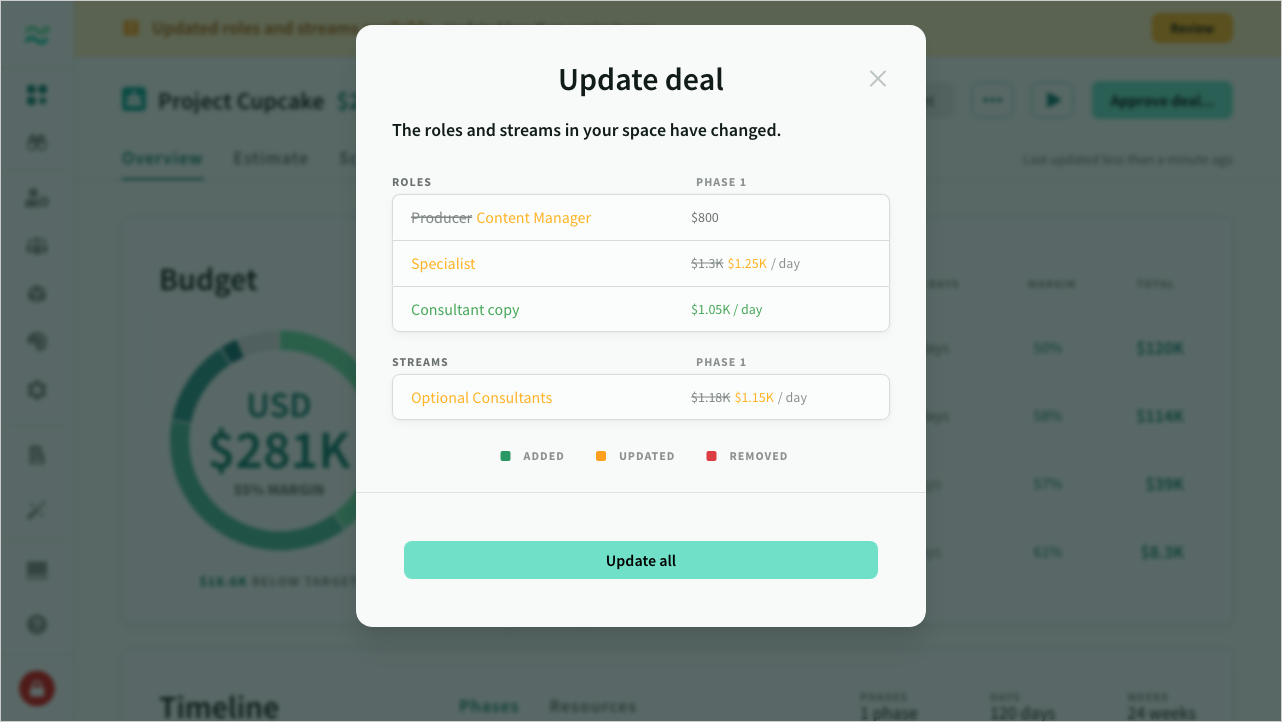 Deal updates panel showing upstream rate and scope changes for review
Evaluating a shortlist
When you evaluate platforms, the shortlist has to answer yes to:
- Can we set margin targets and guardrails centrally?
- Can we keep scope, schedule, and price linked as a deal changes?
- Can we integrate with our CRM without duplicating data ownership?
If a platform cannot, it will become another spreadsheet with a login.
Where Estii fits
Estii is built around the idea that scope, schedule, and pricing stay linked while humans negotiate the trade-offs. Rate cards set the pricing floor and the margin range each deal has to clear. On the scope page, click any priority, item, or workstream to descope it and the price, the schedule, and every breakdown recalculate in the same interaction. Regenerate and the proposal reflects the new scope, new price, new schedule, with an SOW appendix that shows optional units and rates. Deal versions snap automatically on redraft and approval, and updates make upstream rate or scope changes reviewable instead of silent. That is the model three teams can argue over without emailing spreadsheets.
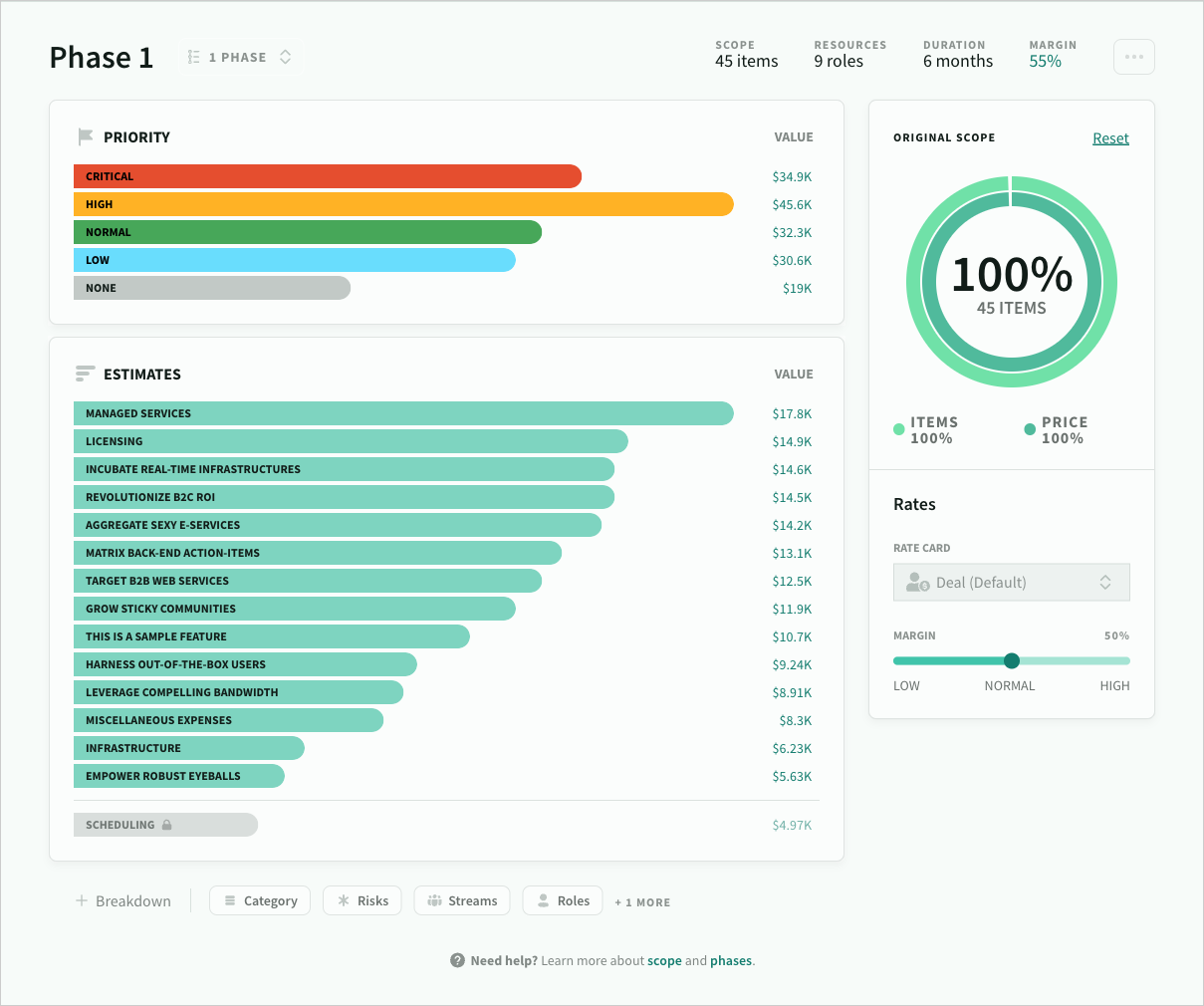 Interactive scope page with priorities and items ready to descope
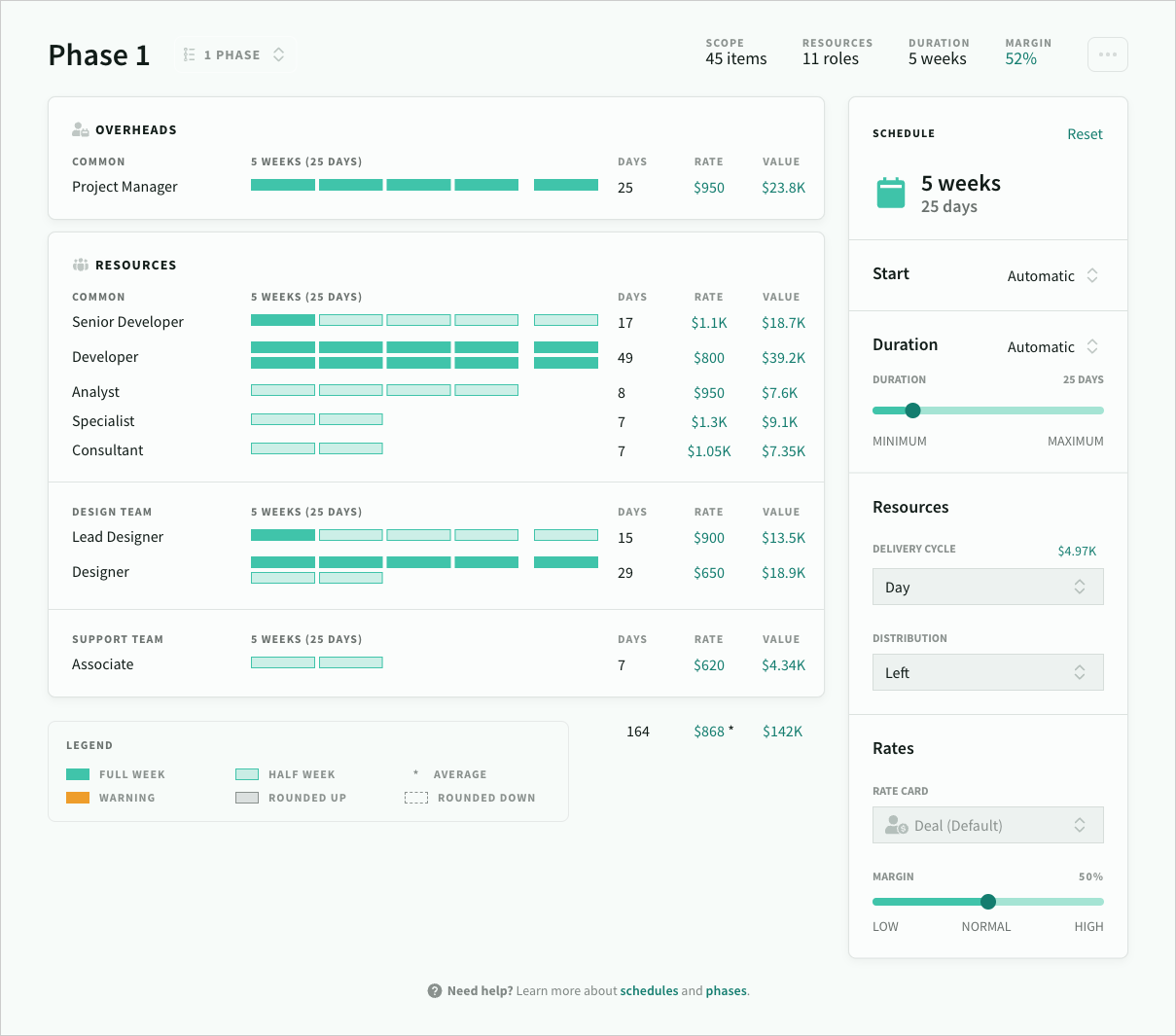 Schedule view recalculated after a scope change
Wrapping up
Spreadsheet-based estimation is not a harmless habit in a services business trying to hit a margin target. It is a structural risk. Make deal economics explicit before signing, give three teams one model to argue over, and let guardrails protect margin instead of hope.
Start with a pilot. Decide on evidence.