
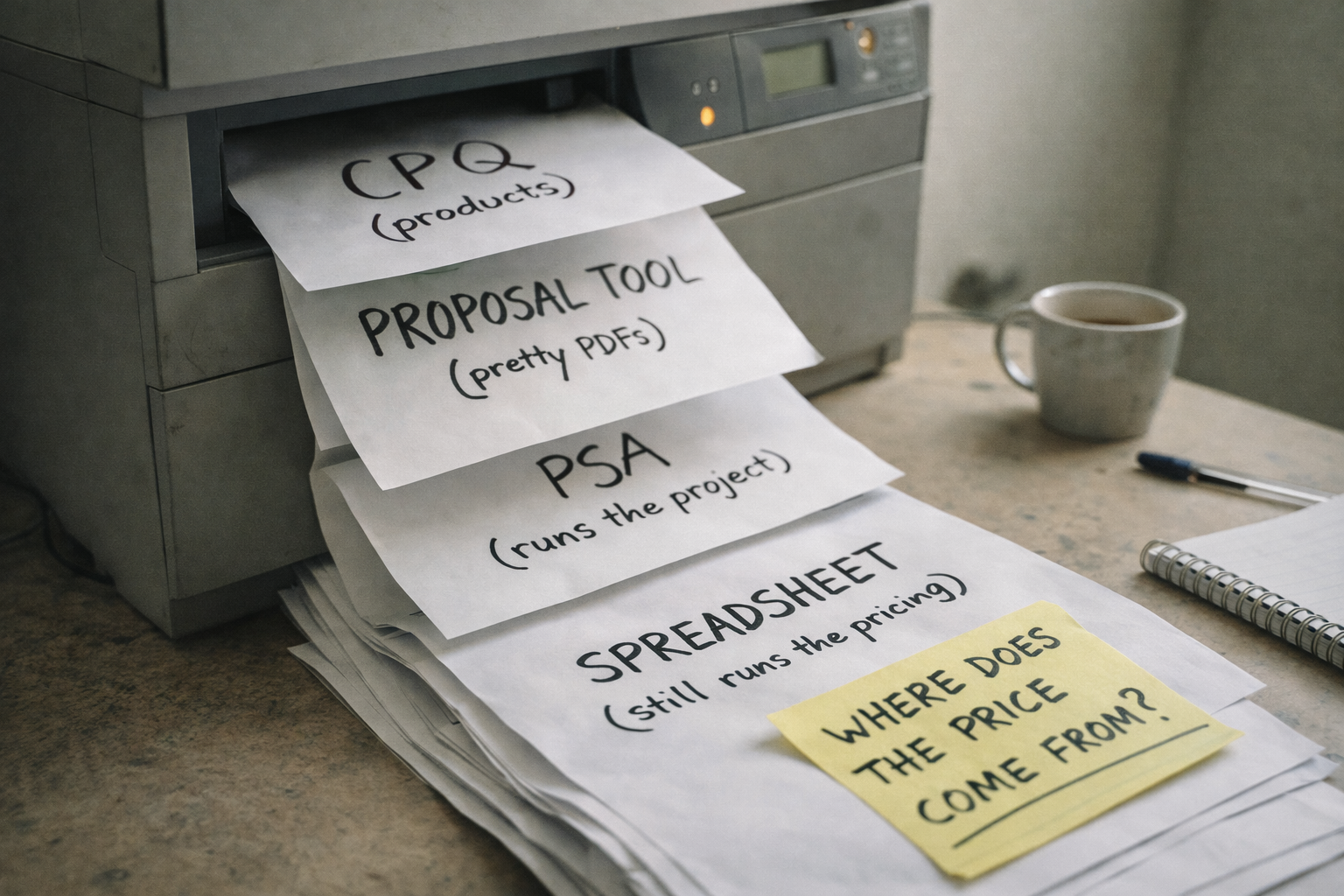


By the time a technology solution provider starts shopping for services quoting software, the same pattern has usually played out at least twice. Someone built a pricing spreadsheet that worked at twenty deals a year. Someone else tried to bend Salesforce CPQ around it. A third person bought a proposal tool and watched sellers paste numbers from the spreadsheet into the proposal tool anyway. The quote-to-cash diagram on the wall has five boxes. Nobody on the delivery team can explain what any of them do.
Services quoting software exists because product CPQ does not fit services. Proposal generators do not price. Spreadsheets stop scaling around the time the firm can no longer track margin by deal. This guide is for founders, heads of presales, and RevOps leads at systems integrators, consultancies, agencies, and MSPs deciding what to shortlist. It covers what the category does, where it overlaps with adjacent tools, and the questions worth asking before you sign a contract.
The shape of a services quote
A quote for a product SKU is mostly a discount decision. Pick the line items, apply the customer's tier, apply the deal-level discount, stamp the PDF. The hard work is approval flow. The commercial model is a price book.
A quote for a services engagement is a different object. It has effort inside it. Scope that someone estimated. Roles with rates that depend on the region and the practice. A schedule that drives when revenue lands and when people are busy. A SOW that encodes the commercial terms. A set of assumptions that protect margin if discovery runs long. None of those live in a price book. All of them have to agree with each other or the deal breaks at some point between signing and invoicing.
Services quoting software is the category of tool that treats that whole object as one model. Estimate, scope, schedule, price, and SOW, linked. Not five tabs in a spreadsheet. Not five separate apps that push state at each other over Zapier.
Most "services quoting" tools in the market do one or two of those jobs. The rest falls back on your spreadsheets or your BD team's memory. That is the first thing to check on any shortlist.
Why product CPQ and services CPQ miss
Salesforce CPQ, HubSpot CPQ, and the rest of the SKU-driven pricing tools are built for a product catalogue, a bundle rule engine, and a discount approval workflow. They fit a firm selling licenses or hardware with service add-ons. They do not fit a firm whose price comes from an estimate rather than a price book.
The adjacent category, professional services CPQ (ScopeStack, Provus, Apropo), closes part of that gap with guided service scoping and SOW generation on top of CPQ mechanics. It is real software solving real problems. It also tends to treat scope as a configurator rather than a live model, and leans on integrations for capacity. The category critique is the subject of a separate guide, professional services CPQ, a category services didn't ask for, which goes deeper on the five gaps. The short version: if your commercial conversation is an estimate rather than a package selection, a CPQ-shaped tool will fit some of the work and leak at the rest.
Why proposal and RFP tools do not quote
PandaDoc, Proposify, Qwilr, Loopio, and the rest of the proposal and RFP automation tools are good at presentation. They assemble branded documents, collect signatures, track opens, and pull content from a library. If your firm's main problem is that proposals take too long to format, they solve that.
They do not price. A PandaDoc proposal with a services pricing table in it is a table filled by hand. Or filled by merge field from a CRM field someone updated by hand. The commercial model lives somewhere else. Usually in a spreadsheet. Which means the drift between the priced estimate and the sent proposal is still there, it just looks better in the PDF.
RFP tools add a content library and a response workflow. Useful if you live in bid responses. Still not a quoting tool. The response copy lives in Loopio. The price still comes from a spreadsheet.
None of this is a criticism of proposal or RFP software. They are doing a different job. The point is that a shortlist mixing them with services quoting software mixes categories. The buyer usually ends up believing they have bought one thing when they have bought another.
Where PSA tools quote, and where they stop
Kantata (the Mavenlink and Kimble merger), Certinia (formerly FinancialForce), NetSuite OpenAir, Projector, and the PSA category generally sit on the delivery side. They run projects, track time, manage resources, bill clients, and recognise revenue. Most of them ship a quoting or pricing module.
Those modules vary more than the category shorthand suggests. Some are light, built for an internal handover rather than a buyer-facing commercial conversation, and shaped as though the deal is already won, which is the opposite of where pricing pressure actually lands. Others are not. Certinia sells Services Estimator as a presales product. PSQuote, now Qvado, is built for services quoting on Salesforce first and delivery second. Both cover margin modelling, capacity checks, approval thresholds, and the path from estimate into project. Treat "the PSA module is light" as a question to test on your own deals, not a fact to assume.
The condition attached to all of them is the platform. The module exists if you already run the suite, and the suite is a programme, not a purchase. That is a fair trade at enterprise scale and a poor one at a hundred people.
Where PSA and services quoting overlap is real. Capacity, forecasting, and resource-level scheduling are on both sides of the line. If a firm already runs a PSA, expect the quoting tool to export into it, read from its rate card, or complement its capacity view. A firm without a PSA should expect the services quoting tool to carry more of the forecasting job.
The category shorthand: PSA runs the delivered work. Services quoting software builds the priced commitment that becomes the delivered work. If a tool claims to do both fully, check which job it does well and which it does as a checkbox.
What services quoting software has to do
A shortlist checklist, organised by the commercial model it has to carry. Ten items. A tool that does six well is a shortlist candidate. A tool that does all ten adequately is usually the choice.
Structured estimation. Not a free-form price grid. Scope at the workstream, feature, or deliverable level, with effort per role, so the same estimate answers pricing questions and delivery questions. If the tool stores the price but not the effort, the capacity and handover views downstream will be empty.
Rate card management. Multiple rate cards per region or practice, margin floors per role, rounding rules that make the final price look deliberate rather than calculated. A rate card tool that is one flat list will not survive a firm that sells across more than one region or currency.
Interactive scope. The commercial model has to bend under pressure. Dropping a workstream should recalculate effort, price, schedule, and milestones in one interaction, not three. If rescoping is a re-do, the firm will not rescope. It will discount instead.
Schedule linked to scope. Effort into calendar time. Role mix per week. A best-fit duration the presales lead can defend when finance asks why the deal takes four months instead of three. This is where most proposal tools drop out.
Payment milestones tied to deliverables. Not dates. Deliverables. Dates slip. Deliverable-linked milestones carry the commercial intent through the change.
SOW generation from the model. A structured SOW appendix rendered from the priced scope, not a Word template with merge fields. Two renders of the same deal: a customer-facing version with headline numbers, and a delivery-facing version with the full breakdown.
Versioning. Every approved quote is a pinned version of the deal. A change request is a new version, priced against the prior model. "The March version" and "the May version" are two URLs, not two files in a folder.
Capacity and forecast. Probability-weighted pipeline, not just signed backlog. Role-level subscription over the next twelve weeks. A deal whose scope changes should move the forecast, not trigger a parallel spreadsheet update. Adjacent category, mostly in the PSA space, but a services quoting tool that ignores it forces a separate integration.
Integrations with delivery tools. Scope export to Jira or ClickUp. Spreadsheet export for finance. At least a real API, not just a CSV.
Approval flow and audit. Margin below floor needs a named approver. A deal over a threshold goes to the head of sales. If approval is a Slack DM, margin discipline is an opinion. Pair that with an audit trail: who changed the price, when, and why. For any firm over fifty people, this is where commercial hygiene lives.
A tool that claims all ten without a screenshot of the ninth is usually lying.
Signals you have outgrown spreadsheets
A few patterns show up early when a firm is past the spreadsheet ceiling but has not yet bought a quoting tool.
The first is the reconciliation tax. Every Friday, someone spends two hours squaring the sales pipeline spreadsheet against the resource-planning spreadsheet against the margin dashboard. The numbers never agree because the three spreadsheets are three snapshots of a moving commercial model. The fix is not a bigger spreadsheet. It is one model.
The second is the estimator variance problem. Two senior presales leads price the same deal and come out 30% apart. Not because one is wrong. The commercial intuitions live in their heads, the spreadsheet carries no rules, and the firm has no floor. A quoting tool that enforces rate cards, margin floors, and role mix collapses that variance.
The third is the change request leak. On any fixed-price deal longer than a few weeks, change requests arrive faster than they get priced. By month three, the delivery team has absorbed 40 hours no one invoiced. A quoting tool that treats a change as a new version of the priced estimate turns absorption into a decision, not a default.
The fourth is the handover argument. The priced estimate says one thing. The SOW says another. The scheduled plan says a third. Delivery spends the kickoff meeting figuring out what was sold. A tool that renders the SOW and the schedule from the same model removes the argument.
If three of those four patterns are showing up weekly, the firm is past the point where more spreadsheet discipline will fix it. The guide on alternatives to pricing spreadsheets covers the comparison in more depth.
Build vs buy vs bend the CRM
Three paths show up on most shortlists. Each has a failure mode worth naming.
Build. A custom pricing tool, usually starting as an internal Retool or a bespoke Django app. Works for the first eighteen months because the person who built it knows what every field means. Breaks the first time the builder leaves, the rate card model changes, or a new practice joins with a different commercial shape. The bill is not the build cost. It is the maintenance cost and the opportunity cost of not shipping product features while the pricing tool gets patched.
Bend the CRM. Bolt pricing fields onto Salesforce, write Apex for rate card logic, use CPQ for the approval flow. Works for services firms whose sales motion is product-plus-services and whose services are secondary. Breaks for firms whose primary commercial conversation is the estimate. Salesforce is not an estimation tool, and rebuilding it into one is a multi-year programme.
Buy. Buy a services quoting tool built for the category. The failure mode here is picking the wrong one. A proposal tool that calls itself a quoting tool. A PSA that calls its estimation module quoting. The shortlist checklist above is there to catch that.
There is a fourth path, which is "nothing changes." At a certain size, nothing changes is the most expensive option. A firm at 150 people with fifteen SOWs a quarter and no commercial estimation tool pays the cost of the missing tool. It shows up in sold-vs-delivered margin variance, not in licence fees.
Where the category is going
Two short notes on where services quoting software is heading, because the shortlist question is "what will this tool look like in two years."
First, AI is a mechanism, not a pitch. Every tool in the category now claims AI-assisted estimation. What that usually means in practice is a model that reads similar past deals and suggests effort ranges. Useful. Not transformational on its own. The thing that moves the needle is having structured historical data to reference. That is a property of the tool, not a property of the model. Tools that have been carrying structured estimates for five years have more to work with than tools that added the feature last quarter.
Second, the line between quoting and forecasting is collapsing. A services quote is a forecast of revenue, a forecast of capacity, and a forecast of margin at the same time. The tools that treat all three as one model are going to win. The current state, where sales signs deals delivery cannot staff, is the expensive problem services firms keep paying for. Any shortlist should weight a tool's forecasting and capacity story heavily.
Where Estii fits
Estii is commercial estimation software built for technology solution providers. It treats the priced estimate as the commercial model, with scope, schedule, rate cards, SOW generation, versioning, and forecasting all rendered from the same object. The mechanics map to the checklist above.
One model, priced, scoped, scheduled
The deal is one object. Scope is an interactive pivot over the deal's estimates. Click any priority, item, or workstream to descope it, and the effort, value, price, and schedule recalculate across every breakdown in the same interaction. That is the "rescope without a redo" property the checklist calls for, expressed as a click.
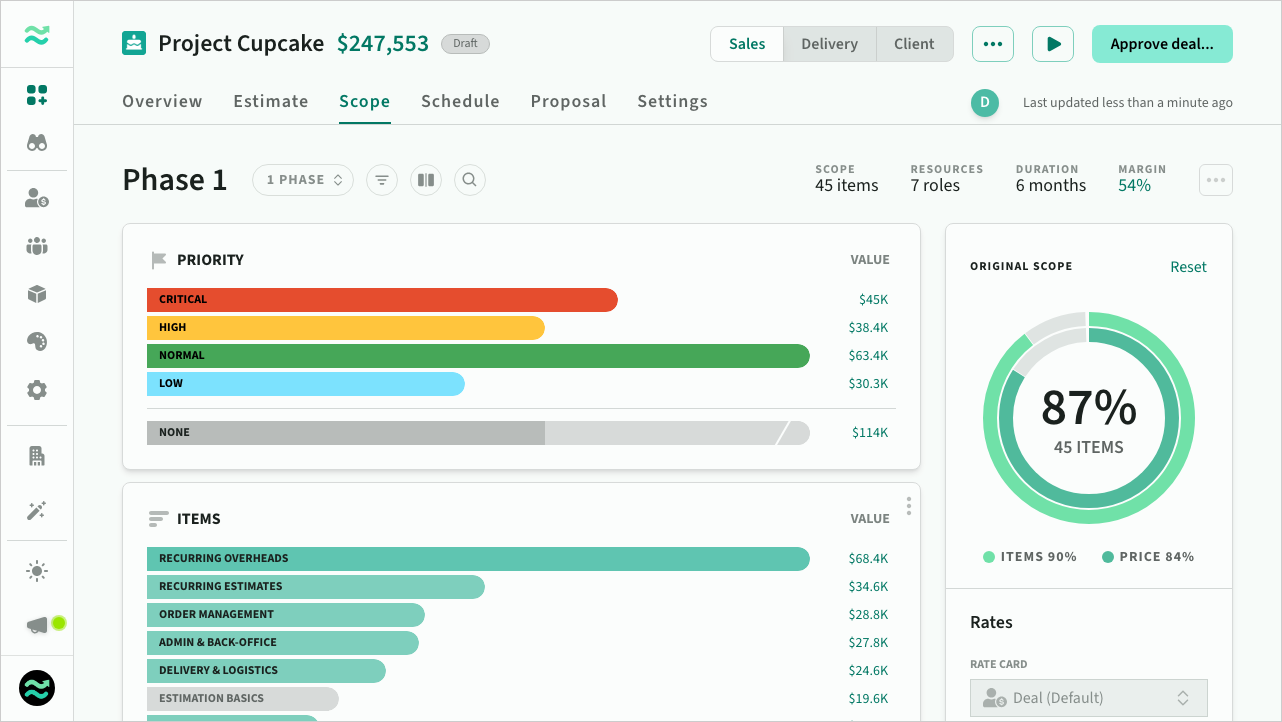 Descope a workstream, price and schedule recalculate together
Schedule cascades from scope
The schedule is not entered by hand. It is a best-fit over the scoped estimates, with a resource plan per role per week. Change scope, the duration adjusts. Change rate card on a phase, margin updates. Payment milestones move with the schedule and can be anchored to deliverables rather than fixed dates.
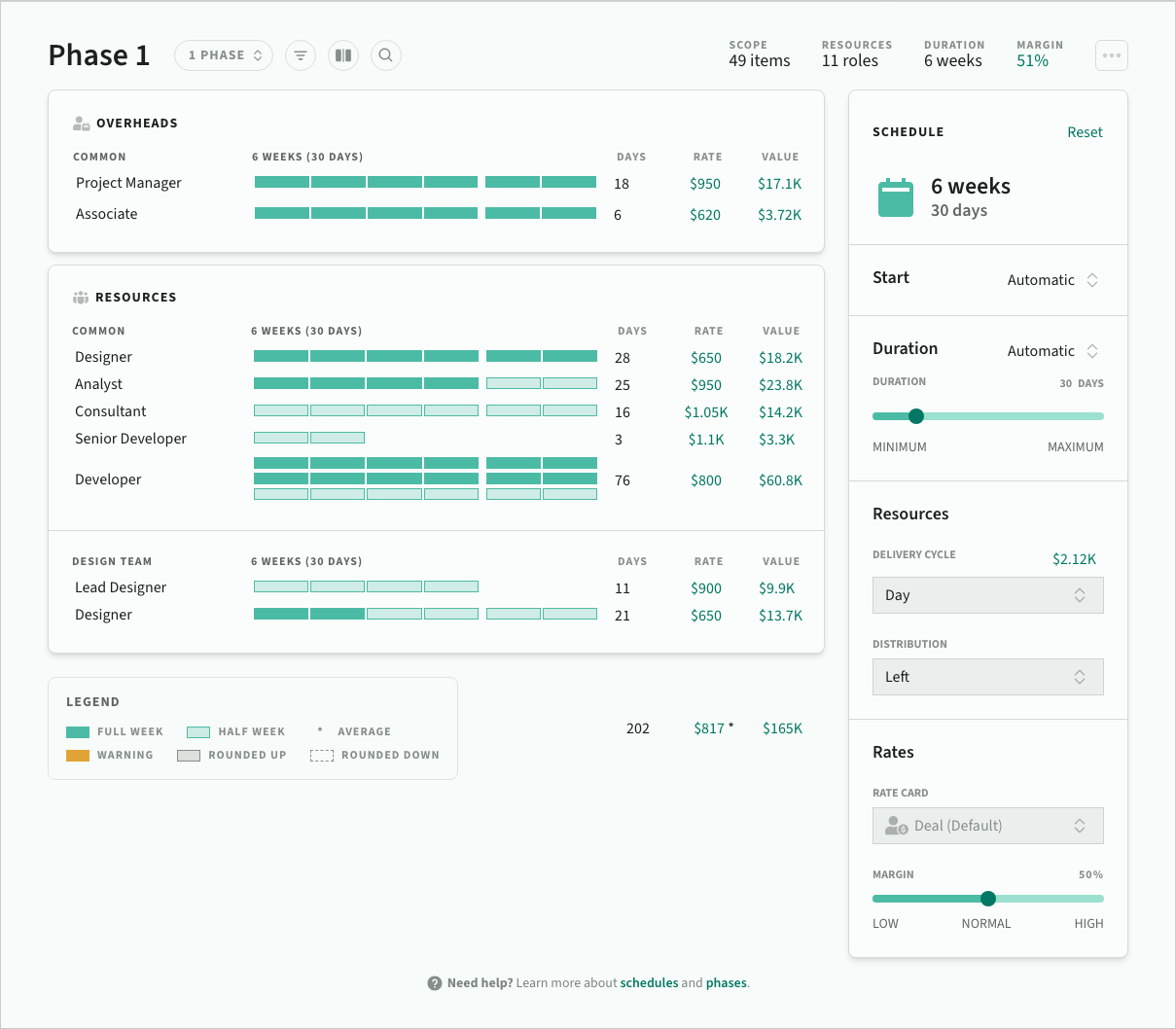 Best-fit schedule updates automatically when scope changes
SOW as a proposal appendix, rendered from the deal
Generated proposals include a structured Scope of Work appendix that itemises every line item by phase, category, and section. Slide settings control whether each line shows role estimates, units, and prices. The same deal can ship a customer-facing SOW with headline numbers and a delivery-facing SOW with the full breakdown. No retype from spreadsheet to Word.
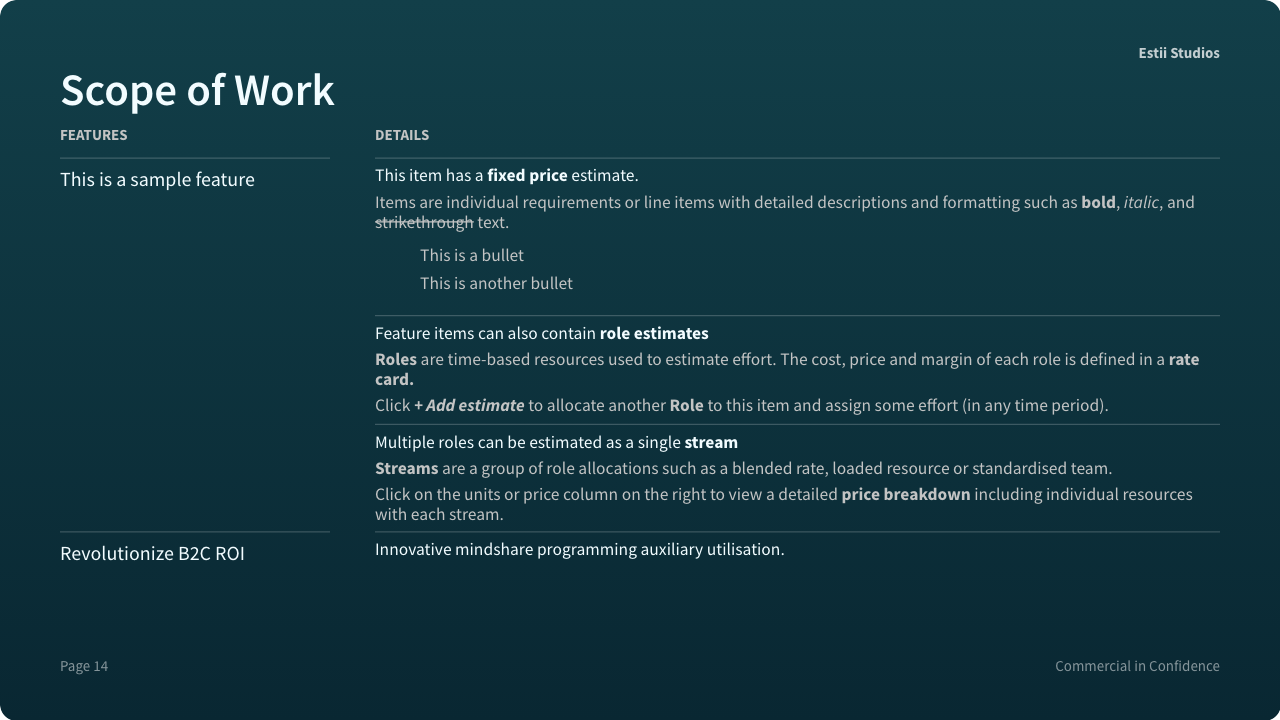 Itemised SOW appendix with estimates, units, and prices
Rate cards per region, margin floors per role
Rate cards are per-region or per-practice, each with its own low, normal, and high margin bands. Manual prices recalculate when the target margin moves. Rounding rules make the final price look deliberate. Deals use the space default until a phase overrides it. That is the "rate card management that survives multi-region sales" property, without a CPQ admin team.
Versioning is automatic
Estii creates deal versions automatically on redraft and approval. Approved deals go read-only. A change request opens a new version without touching the prior one. Every version has a unique URL for preview or comparison, so "what was signed in March" is one click, not a file archaeology task.
 Deal with multiple saved versions and a locked signed state
Capacity and forecast, read from the same model
Forecasts shows capacity over time at three layers: Confirmed, Forecast, and Exposure. The Forecast layer weights every open deal by its stage probability. When a deal's scope or schedule changes in the quote, the forecast updates. There is no separate resource-planning spreadsheet to reconcile. The guide on capacity planning for technology solution providers covers this layer in more depth.
What this looks like in practice
A CFO asks for 15% off a six-figure SOW on a Thursday afternoon. A seller and a presales lead open the deal, descope two low-priority items, change a phase from fortnightly to monthly, and regenerate the proposal. The SOW appendix has the new scope. The milestone waterfall has the new payment schedule. The resource plan has the new duration. The prior version is pinned as "Draft 3, sent 14 Feb." Nothing was retyped. Nothing drifted. The Thursday call ends with a revised proposal in the customer's inbox before the afternoon break.
You can try Estii for free.
Wrapping up
The shortlist question for services quoting software is not "which tool has the best pricing UI." It is "which tool treats the priced estimate as the commercial model, and renders everything downstream from it." Tools that do that hold the firm together as it scales past the spreadsheet ceiling. Tools that do not end up as another tab in the Friday reconciliation.
Most of the interesting decisions happen before the demo. The ten-point checklist above is the one worth running before the first call. The firms that run it end up with a shortlist of two or three. The firms that do not end up with a PSA, a proposal tool, a CPQ bolt-on, and a spreadsheet that still runs the pricing.